Wednesday, December 26, 2007

Wandering Minds and Men, and Wacky Tabaski

Before we get into today's main events, I have a few quick notes.


  • Probably won't do a full Christmas blog entry. I went to a different city in southern Senegal and stayed at a house with a full kitchen. Ten other volunteers were there and we spent four days cooking amazing food (all of it from scratch, of course), and relaxing and watching movies. I may write a blog entry at some point about transportation in this country though, because it's not exactly luxurious, so keep your eyes peeled for that.
  • People were asking me for more direction on what kind of food I would enjoy. I put a list up as a permanent feature and can edit it as I please. It's all stuff that could eat all day, so don't worry if you're duplicating what someone else has already sent.
  • My senior journalism project was published on the BU website as part of a student showcase. If you're interested in seeing what I learned to do in college, check out the link on the right above my list.

Wandering Minds and Men

A couple weeks ago I was walking back to my hut having just pulled a couple buckets of water, when a man that I didn't recognize crossed my path. The first thing that struck me as strange about the man was that he didn't greet me. Senegalese people, especially village people, greet evreybody, so when he stared straight ahead and continued on his course I grew slightly suspicious. The next thing to strike me as strange about the man was that he was completely naked.

A few months ago, I may have dropped the buckets of water in shock and told the story for days, but I'm growing accustomed to seeing things I find odd and I simply can't get hung up on them because it happens too often. And nobody seemed to be making a big deal out of it, so I just continued on to my hut to take a bucket shower and didn't really think about it for the rest of the day.

Later that night, though, one of my friends in the village saw me and said, "Did you see that crazy guy in the village today? He was completely naked!!! Everyone was afraid and stayed in their compounds, peeking through the fence. Except for one woman who tried to give him clothes but he freaked out and refused!"


I am reminded from time to time that Africa isn't an entirely different world. No matter where you are, a man walking naked down the road is weird.


Wacky Tabaski

Tabaski is the most important holiday in the Muslim calendar, falling on a different day every year because it's dictated by the lunar calendar. This year we celebrated on December 21st.

The day began as normal with our normal porridge and wearing our normal clothes, but then the fun began.

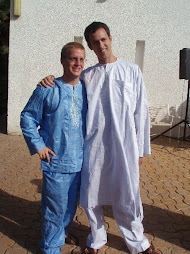
At about 10:00 a.m. the villagers all put on their nicest Grand Boubous and went to the field to pray (our mosque isn't big enough to fit everyone). I stayed behind in the compound playing with the kids and helping my sisters cook the biggest and best meal I've had so far.

When the adults came back from praying I changed into my Grand Boubou too and at about 12:30 we ate lunch.

First dish: findo (a grain) served with a tomato-based sauce that had vermicelli, onions, eggplant, and cabbage. Then fish balls, which have the same basic characteristics of a meatball, except, of course, for the meat.

Second dish: Millet served with large slices of egg-plant on top and some sort of a bird. It wasn't a chicken, but some sort of poultry they had managed to catch in the wild, maybe Guinea Fowl? I never saw it alive.

Third dish: Rice with a peanut sauce and beef. The whole village got together and killed a cow, splitting the cost and the meat. My family got two kilos.

There were more dishes that I didn't eat. My dad warned me that the stomach can handle three dishes without incident, but four dishes would be too much to bear. I had no reason to doubt him and no desire to test him.

After lunch my dad, brother, and I went to a different family's house where some other Dunfaxas live and spent a couple hours just kickin it there. We went back to the house about 3:30 or so where things were pretty quiet so I took a nap and played with the kids a little more.

Once the morning prayers, lunch, and afternoon social scene are all done, Tabaski is pretty much finished. So we had a pretty low-key meal in the evening and then made a fire and sat around that for a while. My dad and I made some rounds in the village visiting some compounds and saying hi to people, and then I hit the hay because I had to make the trek into Kedougou the next day.


Malinke Lesson of the Day

When a baby is born in Malinké culture, it does not receive a name until its baptism a week later. My sister just had a baby and all week we had to call it "Kéékuta" which means "New boy" because he didn't have a name. ps. African babies are tiiiiiny.


Ok, so that's all I'm writing for now. I have lots of little ideas for stories that I keep in my book, but I don't want to overwhelm anybody, so we'll leave it there for now.

Keep the letters, emails, and blog comments comin'

Love Boubs


Grandma

My grandmother, Leona Jondahl, died a couple weeks ago. I considered leaving it out of my blog, but decided to write about her as a tribute. I wrote a letter that my older sister Michelle read at the service:

Dear Leona, Lee, Grannyma, Mrs. Donald E. Jondahl, Onie, Mrs. J, Mom,

Your multitude of names can only hint at the amount of people - and groups of people - with whom you intertwined your life, your efforts, your talents, and your love. But I can only speak for one, so let me begin again.

Dear Grandma,

I want to thank you.

I want to thank you for daring to be an old-fashioned Grandma in the face of the 21st century. For giving me the opportunity to escape to a countryside oasis when the suburban desert just got too hot, and for fighting to your last breath to keep that Big Red Barn as a fixture in the Metro landscape. I know you would never allow me to thank you without giving credit to your partner in farm, so Grandpa, if you're listening, props. Your farm has always been a point of pride and source of bragging rights for me: "Hey. You know that farm by the Carlson Towers and Park Nicollet with the Big Red Barn and all those sheep. Yeah, that's my Grandma's farm."

I want to thank you for making Christmas cookies just the way I like them. Gingerbread cookies with the secret ingredient - duck fat - that makes them sound so gross but taste so good. The spritzers that I could feast on for days without pause or hesitation, or concern for the abdominal consequences.

I want to thank you for fruit jerkey. I am one of few lucky children in the world who has had the dream-fulfilling experience of licking clean a bowl twice his size.

Mostly I want to thank you for your independence, your fearlessness, and your downright stubborness. Although we've found it frustrating at times that things had to be done 'Grandma's Way,' it's that very insistence that nobody else can tell you what's best for your life that I have come to admire in you. As I reflect on our relationship, I see that there might be a little more 'Grandma' in me than I had thought. It's the Grandma in me that led me to a college 1400 miles away, even though Grandma probably wanted me to stay close to home. It's the Grandma in me that led me to transfer 3000 miles to another school, even though everyone told me I was crazy, and then transfer back even though everyone told me I was getting "a little ridiculous."

And it's the Grandma in me that ultimately gave me the courage to depart for another continent, no matter how much I would miss home and home would miss me.

I'm sorry I couldn't be there with you in your final moments. Family has always been your top priority so it breaks my heart that I couldn't be by your side. But I will forever cherish our final phone conversation, and remember how lucky I am that I got to tell you one last time that I love you, and to hear you say it back.

I love you, Grandma.

Tuesday, December 4, 2007

Animals That May Eat Me, and Qu'est-ce que Agroforestry?

I would first like to write about some of the wildlife that I've been coming across out here in the bush, and then I will try to explain what my Peace Corps work will include for the next two years, because those are two subjects about which I've been getting a lot of questions. The work description is a little long and technical, so my feelings won't be hurt if you don't read it, but I wanted to have some sort of reference up for people who asked.

Animals

Many of the animals that I've seen have actually been in the road, either during my morning jog or while biking between Kedougou or my neighboring villages. On multiple accounts I have seen small monkeys. Usually you see them cross the road well ahead of you, and then hide as you come. But I usually stop where I see them go into the trees and look for them. Without fail, they have only gone about 10 meters into the bush and then stare at you as you go by, sometimes darting away when they realize they've been spotted.

Also while running I saw a warthog up ahead of me, staring me down as I approached. Showing no signs of relinquishing his position, I considered stopping my run short - I have no desire to wrestle a warthog. However, just in time, a big truck came by from the other direction and honked at the hog to get out of the road. Warthogs are stubborn animals and he waited until the last second to run off into the grass, seemingly pondering a game of chicken or even a tusk-on collision with the truck. I may have to put my money on the hog.

While riding in a station wagon back from Tamba today (I had gone to visit the bank), I saw a whole family of baboons cross the road right behind our car. Mother, father, some smaller ones and a baby riding on the mother's back. I expected them to be black, but instead found a muddy brown.

One of the birds I've seen most commonly in Senegal is the hornbill, ala The Lion King. They're slightly smaller and skinnier than I imagined, but beautiful nonetheless.

At night I've learned to live in harmony with the small gecko-like lizzards that wander in and out of my hut and hang out on the walls. I assume they're eating bugs, and they never bother me, so I generally just leave them be.


Agroforestry

During my two months in Thies I received training not only in my local language, but also in Agroforestry techniques, and I'll return for more 'AgFo' training in a couple months. "But Andy, what is Agroforestry?" I hear you cry, "What exactly will you be doing."

I don't have the text book definition with me, but basically Agroforestry is the use of trees to increase the production from a given field, and the use of trees for many other purposes.

For example, trees can be planted within a field for multiple reasons: to protect the soil from water erosion, to return nitrogen to the soil to keep it fertile, to drop their leaves to the ground which decompose and provide nutrients to the soil, etc. Often time trees are planted around the border of a field in a "live fence" to keep livestock and or people out (these are usually thick-growing, thorny species" or as a wind break, which are generally tall growing trees that serve to protect the soil from wind erosion, and the crops and or fruit trees from wind damage (a well-protected mango tree will produce more and better-quality fruit).

Which brings me to my next two points. As an AgFo volunteer in Senegal, I am to encourage the production of mango and/or cashew orchards, as these two trees are well-suited to the Senegalese climate. In addition, for trees that have been outplanted in the past couple years, I will show farmers how to "graft" trees, which is basically cutting a branch off of one variety of mango tree and pasting it onto another, by wrapping it with some plastic. The result is a tree with two different genetic maku-ups, and genetic diversity also increases production (this technique is not exclusive to mango trees, but that is the most commonly grafted tree in Senegal).

I will promote the use of all these trees by building a community tree nursery, which I will place in my villages school yard. It will be well-protected there, is close to a water source, and is a good way to get the kids involved and interested in the techniques. In addition, I will give training sessions to farmers and encourage them to build their own tree nurseries (the idea of Peace Corps is sustainable development. We want our efforts to continue to produce results after we leave).

I will travel to other villages in the area as well to promote AgFo practices, particularly grafting techniques.

In addition to my AgFo work, I am also encouraged by the Peace Corps to undertake secondary projects, not necessarily related to AgFo. For example, I plan to help the women with a permanent community garden near a water source so they can continue to produce vegetables (even if only for their own consumption) throughout the dry season. This week, I will be going to a neighboring village with two other volunteers to give a training session on how to build a mud stove (mud stoves are being promoted all over Senegal. They can be produced using locally found free or inexpensive materials, and conserve fuel and cooking rates, allowing the cooks (almost always women) more time to rest - which they deserve - or more time to devote to other productive activities.

So that's AgFo in a nutshell. Hope this makes my life and purpose here a little more clear. Coming into this, I had practically no experience with Agroforestry, and still feel a little clueless, but am using my countless free hours in the village these days to read the AgFo textbook, and manual, and the fruit tree manual, etc. to try to put myself in a position to help these people.

Keep up the love, and thanks for all your comments. Don't be afraid to comment on every blog. It really is encouraging to know that people are reading it.

And continue to send email and letters. When I am around internet I should have a little more time now than I have up until now, because I won't be on such a structured schedule.

Love Boubs

Saturday, December 1, 2007

Reading List

I'm going to post the books I've been reading for a couple reasons: a) I don't want anyone to pay to send me something I've already read, b) To give you conversation fodder for emails if you've already read them, c) I want to show off how much I'm reading, because I've already read more than I did in four years of college.

I'll keep this entry updated, so if you're about to send something, check this first.

Hells Angels, by Hunter S. Thompson
The World is Flat, by Thomas Freidman
Paris in Mind, ed. Jennifer Lee
Confessions of an Economic Hitman, by John Perkins
Bastard Out Of Carolina, by Dorothy Allison
Fear and Loathing in Las Vegas, by Hunter S. Thompson
Another Roadside Attraction, by Tom Robbins
Jazz, by Toni Morrisson
Dubliners, by James Joyce (in the middle of)
The Last King of Scotland, by Giles Foden
The Lion, The Witch, and The Wardrobe, by C.S. Lewis
Life of Pi, by Yann Martel
Gulliver's Travels, by Jonathan Swift (in the middle of)
On the Road, by Jack Karouac
Guns, Germs, and Steel, by Jared Diamond
Extremely Loud and Incredibly Close, by Jonathan Safran Foer
A Farewell to Arms, by Ernest Hemingway
Beloved, by Toni Morisson
A Brief History of Time, by Stephen Hawking
A Moveable Feast, by Ernest Hemingway
A Tale of Two Cities, by Charles Dickens

I'm not on som H.S.T. fix, I just ran out of books in the village and the guy near me had it. Also, note, when I arrived in my village two and a half weeks ago, I was still reading the world is flat. For those of you who know my reading habbits, five books in three weeks hasn't happened since my books had pictures on every page.

Look for the new entry on Weds or so.

Love Boubs

Email Address

Real blog is coming in a couple days, but in the meantime...

If anyone is having trouble commenting on my blog, as many people seem to be, feel free to email me at andrew.jondahl@gmail.com instead.

Friday, November 23, 2007

Hi my name is Andy and I live in a hut

Ok, first of all, I'd like to offer a small outline for this blog, so you can scroll through it for the bits you're interested in.

But before we get started I'd like to mention that the comments on the blog have tapered off significantly. If you don't comment on the blog, I don't know that anyone's reading it, and if nobody's reading it, I may as well just be writing in my journal. So if there aren't like 20 comments or something on this entry, I may never write another one. Dun dun dun....!

Outline:
A) Wish List and New Address
B) Hut/Village Description
C) Day in the Life Slash Food
D) Thanksgiving
E) Malinke Lesson of the Day
F) Final Comments


A) Wish List and New Address

So I've been advised by some seasoned Peace Corps Volunteers to shamelessly put my wish list up on my blog, so as not to burden my parents completely. My address has changed, so if you do want to send a care package, or even just a letter, check the last blog entry for the new addy. Now without further ado...

- Food. Any kind of food you can think of that I might like, I will like. High protein stuff is good, since there's not much meat aroud, like beef jerkey, but also any kind of junk food or packaged food in general is always a treat and would make my month to receive.
- Neosporin. I'm always cutting myself. Can of tuna opened my finger up the other day.
- Hand sanitizer. Gotta stay clean, and I shake a lot of hands.
- A decent pair of tweezers. Impossible to find here, clutch in the event of a splinter in the bush.
- Bugspray. I have rub on stuff, but sometimes it's just easier to spray. And I don't wanna get malaria.
- A leatherman. I know these are expensive, but they come in very handy for a lot of things. I have a mini one that I keep on my keychain and it's priceless, but for bigger jobs i need a bigger knife.
- Photos. Send me pictures of what you're doing in every day life. Pictures of the weather (I showed a picture of boston in the winter to some of my villagers, who had never seen snow before).
- Posters. Gotta decorate the hut somehow. If you do want to send me a poster, probably the best way is to get it online and have it sent to my dad, so he can put a couple together in a tube. Email him for his address if you're interested.
- Books. Anything interesting that you've read, I want. From classics to the new hit. I have lots of time to read.
- Discman. This is the coolest part. I have my iPod and it's great and I listen to it every night. But I don't want to lose touch with the music scene back home. So if someone can send me a basic discman from home, then anyone can mail me a burned CD with lots of their favorite music on it for me to listen to. And stay hip and with it in my music knowledge.

So word, that's my wish list. It's long, I know. And some of the stuff isn't cheap. But I promise that any letter or package that is sent will get a reply from moi. Also, make sure to include a letter, or at least a note, in your packages.


B) Hut/Village Description

I live in a village of 400 people in the region of Kedougou, which is in southeastern Senegal. Kedougoug is absolutely gorgeous, with more elevation changes and greenery than anywhere else in the country.

The ride out to my village is about 37 km and takes me about 2 hours by bike. My village has no electricity or running water, but I do have a small solar panel on my roof to charge my iPod with. I also have no cell phone reception. In fact I'm about 2 hours from it. But that's not such a bad thing, it's kind of peaceful being disconnected sometimes.

My village is organized into family compounds. I live with the village chief and his family. He has two wives (but the second was simply the wife of his brother, that he took in to support when his brother died, and I think their relationship stops there, because they have no children together). A family compound is a fenced-in area with a collection of huts used as bedrooms and one is the kitchen hut. We also have a storage hut to keep the harvest in.

I have my own hut which is huge - 15 feet across - and circular. It has a thatched roof and a cement floor, with a front and back door. I also have a fenced-in backyard of my own and a small fenced-in area to use as my bathroom. In my hut I have a bed made of bamboo poles with a foam mattress and a three-tiered table also made of bamboo. I have a small gas can with a stove attachment so I can cook.

I don't know what it is about the sky in Africa, but somehow it just looks different. Every sunset is breath-taking. A few whispy clouds always seem to wander into the western sky just in time to be painted by the sun. The sky almost looks smudged some evenings, like an impressionists painting.

My camera is broken and a new one is en route, so I don't have any pictures yet. But be sure that you already know what my village looks life. When Hollywood went to Africa for a day to see what a village looked like in Africa, I'm pretty sure they came to mine because I laugh every day at how cliché it looks.


C) Day in the Life Slash Food

I wake up at about 8:00 am every day and go for a jog. Any villager that I run by usually asks me where I'm going and laugh at the idea of running just for the sake of running, but I'm sure they'll get used to it.

Then I come back to my hut, get my bucket and an extra T-shirt and walk to the well, which is about 150 meters away. I pull my water by hand - no pully - and fill a 5-gallon bucket to the brim and put a lid on it. I'm the only man in my village who pulls water because it's considered women's work, but I'm trying to rock their ideas of gender roles a little bit.

After carrying the water back to my hut on my head, using the extra T-shirt as a head mat, I eat breakfast. My family is up and has eaten before I wake up, so I eat breakfast alone in my hut, which is mono, that porridge I've written about before. It's possibly my favorite part about Senegal so far. I also make a cup of coffee.

Then I use the water to take a bucket bath in my backyard and get dressed to go about my day. So far I've only had a few days in the village but I've been using them to meet people, travel to other villages to meet farmers there, and I've gone into the fields with my family to do work out there twice.

Lunch generally comes around noon and is rice or findo (a very small grain) covered with a sauce. The sauce is usually made out of leaves, or is peanut based, often times with okra, which makes it sort of slimy. Dinner is usually similar to lunch. Sometimes with the sauce is whole okra or pieces of this orange squash that is sweet and delicious.

At some point in the afternoon I try to make it into my hut for a good nap. Then I like to spend my afternoons reading or studying Malinké (which is extremely similar to Jaxonke, but not the same). I hang out in my compound with the fam until dusk, at which point they say their prayers and then we eat immediately after dusk.

Often after dinner I go to the teachers' hut (i have a small school with three teachers in my village). The teachers speak French and are extremely nice and welcoming. They have told me that I'm already a member of the family, and am welcome at all times of the day. They eat much better than my family, and sometimes even have meat, and eat later than my family. So, often I eat dinner twice. Even so, I usually eat at least a clif bar every day.

Then I go back to my hut around 9:00 or so, shut the door and have some Andy time. I listen to music, read, write in my journal or write letters. I also usually make oatmeal or eat a can of tuna. Then at about 10:30 or so head lamp is off and I'm asleep. And that's a day in my life.


D) Thanksgiving

All the volunteers from the Kedougou region came in to the regional house, which is in the city of Kedougou, to make Thanksgiving dinner together. The regional house doesn't have electricity but does have a small stove and oven, and also has running water. It's more of a compound than a house, with a collection of huts that we use.

The volunteers who have been here for a while have gotten extremely creative with their cooking so we had a great meal:

We had chickens and ducks (turkeys were 80 bucks a pop) that we cooked on the grill. We had garlic mashed potatoes and turkey gravy (the gravy was sent in packet form from home). We had delicious mashed sweet potatoes with a bissap mirangue on top (bissap is a flower here that they also use to make juice). We had fresh baked bread - sourdough, rosemary, and something else. We had stuffing made from scratch, right down to drying the bread ourselves. We had green been caserole made with a can of mushrooms and powdered milk because we couldn't find cream of mushroom soup. We had a delicious carrott and raisin dish that someone dreamed up. For dessert we had squash pie (no pumpkins around) lemon bars, a fudge cake, a chocolate-peanut butter pie, and cream. All of these were made from scratch, including the crusts. Betty Crocker and Baker's Sqaure took the day off.

So while I did miss eating with you all, we did have a meal of which any American could be proud, despite the lack of turkey.


E) Malinke Lesson of the Day

"I speak Malinke" and "I speak English" are "Nse Malinko kan mee" and "Nse anglais kan mee." Directly translated that means that you "hear" or "understand" the languages. I think it's an interesting difference in approach, that once they learn a language they say they can hear other people in it, whereas once we have learned a language we "speak" it.


F) Final Comments

With that I congratulate anyone who managed to get through all of this. I know it was long but people have been asking me for different things on here and I wanted to make sure I had something for every one. Keep giving me ideas for what you want to hear about.

And don't forget to write comments, or I may never write anything again.

Love Boubs

Tuesday, November 20, 2007

Address

I'll be back on tomorrow to write an extensive blog about my first week in village, but I did want to quickly get my new address up.

PCV Andrew Jondahl
b.p. 37
Kedougou, Senegal
West Africa

Phone number is the same. Call me, I'll have service til Fri morning.

Love Boubs