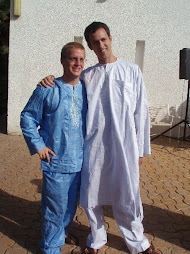
Tuesday, July 22, 2008

The Middle of the Earth, Bumpin' Basketball, and God Bless America


The Middle of the Earth

My life consists of more than baboons, but my experiences with the noisy creatures seem to be some of the most story-worthy. Forgive me if you’re bored of the baboons, I promise I’ll switch to some different subject matter for the next entry.

My village lacks power, running water, and cell phone reception, and is at least 16 hours by car from the capital city – as far as Senegal is concerned it is off the “beaten track.” However, I recently realized that it is relatively accessible.

I heard about a village from a former Peace Corps volunteer with some mature mango trees that fruit a lot because a couple forward-thinking farmers planted them twenty years ago. Many of the villagers in the surrounding area go to this village by bike to buy the inexpensive mangoes and then sell them in their own villages for a profit.

One day in April, I went to this village with a friend of mine who wanted to buy some of the mangoes. After leaving the main road that my village is on, we biked 17 km into the woods on a bike path that you couldn’t drive a car down. We occasionally had to dismount our bikes to traverse steep, dry, riverbeds, that are now undoubtedly filled with water after the rains we’ve had lately.

After an hour and a half of biking in the bush, I found two family compounds, and a total population of sixteen people. Each of the men in the village had a shotgun strapped over his back and a string of cartridges around his waist. While it appeared strange at the time, strange has become the norm for me and I quickly forgot it - until I heard a shot. Moments later one of the man dragged a baboon by the tail to the center of the mango grove where we had been eating freshly fallen mangoes with the other villagers. Not wanting the baboon to go to waste, they skinned it and hung it up to dry to be eaten later.

A couple hours later everyone started shushing as one man ran off. This time I watched him take a knee, take aim, and fire at the second baboon of the day. With more than enough meat for the day, and no means of refrigeration, they gave the second baboon to the dogs for a meal.

While I was initially put off by the seemingly senseless killing, they explained to me that the mango trees are the village’s main source of income, and that if the baboons were left un-hunted, they would eat the only revenue the village had for the entire year. For the two months that the trees are fruiting, they are on 24-hour patrol, with somebody even sleeping in the orchard.

Even though strange has become the norm in my life, my day spent out in this village was surreal. I didn’t feel as if I was at the end of the world, more so somewhere in the middle in a completely forgotten pocket of it. It’s illegal to shoot baboons in Senegal, or even to have an unlicensed firearm, but being in this village I was reminded that sometimes laws simply don’t apply. To be in a truly lawless, and yet peaceful and functioning micro society, was actually a reassuring – even if a violent – experience.


Bumpin' Basketball

Kedougou has a basketball court in town funded by a U.N. project years ago. The court gets almost daily use thanks to a Brazilian missionary who runs a pickup game every evening and who also conducts workshops and lessons.

One of our volunteers played basketball in college and started participating in the pickup games and convinced a few other volunteers to join, so we strapped on our tennis shoes and went down there, even if a little apprehensive to walk onto a court where we didn’t know anyone. The Senegalese guys were not only great basketball players, but also incredibly nice guys. After a few of us had played with them regularly, they suggested the idea of a Peace Corps vs. Senegala full court game. Thinking it would be a fun, casual game, we agreed, and set a date to make sure everyone was in town.

On the date in question we all set out from the regional house bound for the basketball court and found fifty or more people congregated at the court. The court regulars had chosen their most loyal ten to play on the team against us, and each of them had chipped in to pay for a sound system and DJ to blast popular hip-hop music while we played. They had mesh jerseys ready for us – they played in red and we in green. A referee was ready complete with whistle and we played four ten-minute quarters.

The game was entirely light-hearted and jovial, despite the fact that they dominated us. We all shared some cold hibiscus juice at the end and took some great group photos. The crowd that had gathered to watch the game cheered equally for every basket. They rushed onto the court at the end, most of them putting their cell phones in our face, pretending they were microphones, and interviewed us about the game. One even complained to the Brazilian missionary, who had organized the entire game, that the Senegalese national media hadn’t been invited; they’re promised for the rematch.


God Bless America

As a volunteer in Senegal I am constantly striving to better understand the culture and customs here, and to assimilate seamlessly into their traditions. However, sometimes I need to act and feel American to preserve my sanity, and the 4th of July offered me the perfect opportunity.


The Kedougou regional house offers a perfect setting for a 4th of July party, because it’s a mostly outdoor compound, lending itself to the vibe of a typical American barbeque. So we invite every volunteer in Senegal - and any other Americans we run into - to come to Kedougou for a big party every year.

This year we had about eighty people, including ourselves, for a crazy day filled with horseshoes, flip cut, beirut, foosball, a professional sound-system and DJ and even a man-sized piñata. We had tiki torches lining the walkway. We had a large party tent set up for food and another for dancing.
We cut up, marinated, and grilled an entire pig, topped with two large bottles of BBQ sauce that conveniently arrived in a care package days before the party. We made 15 liters of potato salad, 15 liters of coleslaw, and over 20 liters of pasta salad. We baked loaves of bread and cut up veggies to dip in the homemade hummus, baba ganoush (sp?), and a dill yoghurt sauce that we made. We had M&M cookies, peanut butter cookies, brownies, and mango cobbler for dessert.

While we may not have had the spectacular fireworks display so commonly associated with our Independence Day, the party certainly felt like our own slice of American apple pie, even if the pie served was made from mangoes.

Monday, May 12, 2008

Drummers, Inc. and Misguided Adventures

Given that my past couple posts have been largely about the work I'm doing, I decided to focus this one on the Senegalese culture and my place observing it and participating in it. The first entry is a transcription of a journal entry I wrote on January 4th, but decided some people might find interesting, and the second story is a description of some of the things I've experienced over the past few days. Enjoy!


Drummers, Inc. January 4, 2008

On January 3rd I wrote that I had heard drums playing from across the village while I lay in bed, but hadn't had the motivation to get up and explore.

They say patience is a virtue. I'm back at the writing block tonight because I need to write about what I saw. After putting down the pen as Pops arrived at the fire, more and more people came out of the dark and we had our regular, peanut-cracking bonfire party. They asked if I had heard the drums the night before, which I obviously had. Pops told me that they'd be playing again tonight and that we could go over there later on. Soooo I stuck around past my normal 9:00 hut-time and talked with Sira a little. Just as I began to wonder if I had misunderstood Pops, a few faint bass beats drifted across the chilly village into our compound.

Pops and I went over there together - he with the hood of his windbreaker up, I in a small white T-shirt. The drums, which had picked up in pace and volume, were all the way on the other side of the village. Somebody explained to me that these two drummers go from village to village playing as their form of livelihood.

We entered the compound to find a group made exclusively of women - save the two men drumming - and a small group of young boys. They stood in a circle clapping and singing while one or two women at a time jumped into the middle to dance.

I felt lost between cultures. The women were mostly attired in traditional dresses of bright colors and intricate patterns with shauls to match, and they sang Malinke songs. One woman would sing a line and the others would reply (but not repeat) in song. To that extent I found myself in a cliché African drum circle. But they weren't lit by fire or torch light, the spot light that illuminated the middle dancers came in the form a flash light held by Pops, powered by D batteries.

The drummers themselves were a cultural paradox. They played nearly impossible African beats on hand-made drums, but wore knock-off Golce&Gabbana jeans and lit up a cigarette in the middle of a song.

The display of rhythmic independence and adapation amazed me. I couldn't find a common beat between the singing and the playing but there must have been because both drummers and singers continued without falter in their own rhythms despite each other. Perhaps there was a common rhythm and my sluggish ear couldn't hear it.

Sometimes a dancer would march up into the face of the drummers and almost challenge them to a battle. Herein lies the rhythmic adaptation. Once in a while the drummers would change beats unexpectedly (at least to me) but one beat later the dancer would be right with them. I was slightly impressed by that, but not surprised. Good dancers can always follow the music. My surprise came when a dancer spit her own change of beat right back at the drummers, who both adapted - perfectly in sync - as the entire package continued through the night.

The group of little boys behaved as any group of boys does at a dance. I think this is universal: They would dare each other to go dance until one finally got up the courage to jump in the middle, where he would shake his body for three beats before running out embarrassed.

Senegalese dancing seems to be all about the footwork. They will try to fool you with large and distracting arm movements, but I think those are for balance. The real dancing goes on at ground level, where the black bare feet chatter and stomp, occasionally kicking up behind to reveal their pale, calloused underside in a small cloud of dust.

As I write this I can still hear the unrelenting beat and unison singing. Pondala can be so romantic.


Misguided Adventures

An area known as 'Basari Country' lies about 80km west of Kedougou. It is named for the minority ethnic group, the Basaris, who inhabit it. The Basari people are comprised mostly of animists, meaning their religion is based more around nature and the soul of every object rather than one supreme being (I think). About 25% of Basaris are Christian converts.

Every year in May the Basaris hold an elaborate initiation festival, complete with masks, ritualistic dancing, and one-on-one combat. I had seen pictures of the ceremony in books and it definitely seemed like everything you'd hope for from a tribal African ceremony. They keep the date of the ceremony a secret until a few weeks before, but it's always a Sunday in May. Our sources told us this year that it would be May 10th and 11th.

A few friends and I decided to bike out to the Basari festival and to visit a few villages along the way to make a small vacation out of it. First we visited my friend Jordan in his village and looked at some of the work he did. We spent the night there and then went to my friend Amy's old village (she had to change her site after a few months of service because the water situation in this village was so dire).

In the second village we decided to put together a skit in Malinke for the village people about the importance of bug net usage in the prevention of malaria. Many of the women in the village came after dinner and really got into it and laughed at all the jokes. When the skit was finished we sarcastically told the women that they had to put together a piece of theater for us. However, they took us seriously and threw something together in moments: a skit, complete with props, about women going out fishing with nets and the difficulty of catching fish. After the skits, we sang for each other in English and Malinke. Later the young girls in the village played a game for us similar to Red Rover that involved a beautiful call-and-response song. The game quickly evolved into a dance circle similar to the one I described in my journal entry, but this time there were no drums, only clapping and singing, and six rhythmically incapable Americans were trying to participate.

One of the other volunteers asked me to beat box a little to provide some music for the dancing. So we told them all to stop clapping, because now it was time for some "musiko Americain." The little girls loved it and danced away. Later, one of the grown women came and asked me to give her another beat because she really liked dancing to the American music, so we got it going again and it quickly turned into a dance party with everyone dancing at the same time. Nobody had their cameras out for that night, but I'm content to have these memories saved in my head. Sometimes cameras change everything.

The next night we biked to Salemata, the big town near the Basari initiation festival village, brining our biking total to about 85km. Upon arrival, we saw a driver that we knew and asked him if he knew of anywhere that we could pay to wash up a little, as we were disgusting from the ride. "Of course not," he said, "My friends house is right over here, you can wash up for free there." So we sat down in this stranger's house and washed and sat in the shade and ate mangoes. We asked his friend if there were a small restaurant around where we could buy lunch, "There is," he said, "But they don't know how to cook. My wife is a much better cook. We'll cook for you." So we bought a bunch of food and had an amazing Senegalese meal for lunch.

After lunch we locked all of our bikes up in one of his huts, because the path up to the village is so narrow you can't even push a bike along it. The hike is about 6km through mountains. Despite the lack of rain over the past 5 months, some of the views were absolutely breath-taking. I'll be sure to go back in the rainy season. The driver's friend walked with us for a while to show us the path, and then went back to Salemata. Suddenly we found ourselves hiking through the African mountains, miles away from cell phone reception, on the assumption that we had been shown the right direction.

The path split a couple times and we luckily found a couple random people in the mountains that we could ask for directions. As time dragged on and we couldn't hear the chanting of the ceremony, we grew suspicious that we were on the right track. We found a young boy and asked him if he knew where Eshelo was. "Are you going to the campement there (collection of huts that makes up a rustic hotel)?"

"Eventually we want to go there to sleep tonight. But right now we want to go straight to the ceremony."

"That's impossible, the ceremony is next weekend."

So after a three-day trip and and a hike over a mountain, we learned that our sources had given us the wrong date. Discouraged, but not defeated, we followed the boy to the village, where we found our friends who had decided not to bike and took a car (up a different, much wider but much longer path). Now we numbered sixteen. The villagers confirmed that we had come on the wrong weekend, but invited us to drink home-made palm wine with them. We accepted the invitation, brought our luggage to the campement and returned to the village center with empty water bottles to be filled from the buckets wine. I have never consumed a drop of alcohol with a villager because almost all Malinkes, Wolofs, and Pulaars are Muslim and so are forbidden to drink.

We integrated ourselves well into the group of villagers and talked to them in our respective languages. While we were a long way from Malinke country, I did find a few men who spoke at least enough to communicate. We saw a man smoking home-grown tabacco from a pipe he had wittled and asked if he had any more to sell. He brought one up and told us we could buy it for about a dollar. Two of us were interested in it and started to play paper-rock-scissors for who got to buy it. When the man realized what was happening he immediately offered his own pipe for sale, so we both left happy.

As the sun disappeared and the villagers worked up an appetite, they started to disperse to their homes for dinner, and we returned to the campement, where the cook had prepared a large chicken dinner. The next day the owner of the campement gave us a small information session about the Basari festival, in lieu of actually observing the festival itself. Later we hiked down the mountain where a car waited to drive us and our bikes down to Kedougou.

While I'm disappointed that we missed the festival, and definitely don't have time to return this weekend, I will remember the weekend for the rest of my life. Tourists go out to watch the initation every year, but I'm assuming few ever go out just to socialize with the villagers. The journey there proved to be a much more interesting destination - one without an information session to accompany it.


Malinke Lesson of the Day

The woman who asked me to beat box again told me she liked it by saying, "Boubacar la sigo diyata!" 'A diyata' is a versatile phrase used in Malinke to say that you like something. It can be used for food, cities, or even songs. We really don't have a direct traslation in English.

Tuesday, April 1, 2008

Beeware of the Well and What's Work


Beeware of the Well

We have officially entered the hot-dry season in Senegal, with temperatures over 100 degrees during the day, and having had no substantial rain since early November. As we get deeper into the hot season, before the rains come in late May, most small streams and ponds have been drying up, leaving the Gambia river as the only local above-ground water source.

It never occured to me before arriving, but bees need water to make honey, and as all of the natural above-ground sources disappear in the woods, the little yellow and black soldiers have been coming into the villages on water missions. They swarm around our well and our hand pump to get any water that is spilled on the ground, and even to drink from the buckets as they are pulled out of the well.

The women walk calmly into the swarm and throw their bucket down into the well, pulling out load after load. Having faced my fear of baboons, I thought bees would be easy. So I centered my zen and walked right into the swarm. Just as I finished filling my bucket I was stung on the wrist. I thought I just hadn't found my peace with the bees.

The next day I tried again, taking a deep breath and trying to "be one with the bees." But this time I somehow managed to infuriate a particular bee who started taking nose dives at my face. I started dancing around, swatting him away and swinging the bucket at him, but finally gave up and fled. The angry bee hadn't finished with me, though, and gave chase, swinging around in front of me and stinging me right smack on my upper lip. While a painful experience for me, my ballet with the bee provided a good piece of entertainment for the villagers watching.

The following morning I was determined to outwit the bees. The girl who served in my village before me said she had left some bee-keeping equipment in my hut. So before heading out to pull my water I suited up in full bee-keeping garb, complete with a mask and heavy leather gloves. I expected the villagers to fall over laughing at how ridiculous I looked, but while some giggled, most had an unexpected response: "Boubacar, that is a really nice suit."


What's Work

Last Friday, I had the busiest day of my Peace Corps service.

In anticipation of the rains in May or June, my first busy AgFo work season has arrived. In order to give trees a decent chance of survival, many species need to be started in a nursery for a few months so they get a chance to become seedlings before outplanting them to their permanent homes. We try to outplant our trees at the beginning of the rainy season so they can be watered regularly for the first few months after outplanting, so we are beginning our nurseries (or pepinieres, as we refer to them) right now.

So last Friday, I had to go to four villages to arrange days to come out and do pepiniere training sessions. I left my village in the morning, and then spent my day going to the farmers in the villages and asking them to prepare the locally available materials needed (manure, sand, ash). In the evening I went to the biggest town near me - not Kedougou but a smaller town named Saraya - to have a meeting with the director of the local radio station there. This Saturday night another Malinke speaking volunteer and I will be hosting a one-hour show, completely in Malinke, about how to construct a tree nursery, while also playing music of our choice.

Finally, after 120 kilometers on the road, I made my way back to my village, exhausted and barely able to move, but feeling satisfied with a productive day of work.

Thursday, March 13, 2008

Tales from the Borodula and Motivation Nation


Malinke Lesson of the Day

The Malinke Lesson had to come first today so you'd understand my first title. I think I've already mentioned that I jog some mornings and that some people have a hard time grasping the concept and always want to know where I'm going. The concept that I would run without a destination doesn't register. So they've compromised, and decided that I'm going to the "running place" - borodula. People often ask me, "Did you go to the borodula today?"


Tales from the Borodula

A few weeks ago I left my hut for my morning jog like any other day, and followed my normal course. About ten minutes down the road I saw some animals up in the distance. "Are those baboons?" I asked myself, "I haven't seen any baboons in a while, awesome!"

As I approached and their images became more clear, I verified that they were, indeed, a group of about seven or eight baboons. Usually, when I approach baboons in the road, whether on bike or foot, they run into the woods when I get close. But these baboons just sat and stared until I was uncomfortably close. I considered turning back to avoid conflict, but decided I couldn't live through two years of baboon fear in Africa, so stayed the course.

Just before we would have met, they ran into the woods. I stopped where they ran in to peer into the woods and get a better look. I expected to see their backs as they ran away, but instead found a group of twenty or thirty standing about fifteen meters deep in the trees staring right back at me and barking ( a baboon sign of aggression). One stood up on his hind legs and measured - at the very least - as tall as I.

With no interest in a baboon brawl, I continued on my jog, hoping to leave them behind. But instead they remained about fifteen meters deep and ran next to me. Contrary to monkeys, baboons make a lot of noise moving through the bush, so I was all too aware of their presence as they crashed from tree to tree and along the ground. Finally a big truck came from the other direction and scared them all deeper into the woods and I could finish my run in peace - almost.

I got to my turn-around point and headed back to my village. As I ran past the same place that I had seen the baboons before I crossed my fingers that they wouldn't be back. Luckily, they weren't in the road waiting for me, but when I was about 100 meters past the point, three of the biggest came out into the road to stand on their hinds and bark, as if to say "And don't come back!"


Motivation Nation

Peace Corps Senegal received a new Country Director (CD) almost exactly as I arrived, and the entire program has been in dramatic transition ever since. Volunteers who have been here longer constantly remind me of how lucky I am to be here with such a motivated adminstration and tell me they envy my position and the work I'll be able to do.

A point the new CD emphasizes more than any other is cross-sector collaboration. A common criticism of Peace Corps is the lack of communication within the organization and a consequential lack of effect on our communitites. Peace Corps Senegal has six sectors of volunteers: Agroforestry Extension, Sustainable Agriculture, Urban Agriculture, Health, Environmental Education, and Small Enterprise Development. In the past Agroforestry volunteers and Small Entrerprise Development volunteers conducted their projects independently of each other, with no infrastructure in place to share ideas or offer each other help. Each volunteer had his/her own agenda and did what he/she could to help his/her own village (sorry for all the slashes in that sentence - just trying to live the gender equality I preach).

The new CD wants to not only encourage, but actively enable cross-sector collaboration through an overhaul of the current system. He has chosen the volunteers in Kedougou as his pilot group, partially because we're one of the smallest, most manageable regions, and partially because he is a former Kedougou volunteer and has no shame describing himself as "Kedougoucentric."

On Friday all the volunteers from Kedougou went to Dindefello, a near-by village with a small, rustic hotel and a beautiful waterfall, to draft a Regional Strategy and six-month action plan. We used the Millenium Development Goals created by the U.N. as a launch board and created a realistic, practical strategy for the development of Kedougou until the year 2015. We addressed the broad areas of Malaria, Nutrition, Food Availability Extension, Economic Growth, Water Availability / Santitation, and Protection of Natural Resources. We discussed not only the work that we can do, but also work that other NGOs can do, with a plan for how we can all collaborate toward a common goal. From that, we created a six-month action plan for the volunteers of Kedougou,with specific projects and concrete, quantifiable goals, and a point-person for each project.

It was a weekend of long hours and tedious work (on Saturday we worked from 8 a.m. until 11:30 p.m.) but we finished with a document of which we can be proud. The energy of our group has drastically changed and we are more excited than ever to attack our goals with vigor and hold each other responsible for the good work we are committed to do. As I looked around the group, I realized that never in my life have I been surrounded by a group of individuals that I found more intimadating and humbling. However, they are simultaneously so supprotive and encouraging that those forces will serve the positive roll of helping me find the initiative to get projects off the ground. I really am in the Motivation Nation.

Friday, February 22, 2008

Senegal Nice, Life Takes VISA, and WAIST

I apologize for my blog neglect over the past month, but be assured that I used the time productively to learn new things about Agroforestry, take a short course in Pulaar (another language spoken in my area), socialize with my friends from training, and play some "serious" softball - details to come.

Now that my training is finished and I have "entered my community" from here on out it's just hard work. I get started as soon as I arrive in my village and won't stop until I get home in two years (except for my daily nap, of course).


Senegal Nice

While the Senegalese people can sometimes be aggressive and demanding for cadeaux (gifts), I have had two experiences over the past two weeks that attest to their honesty and hospitality.

Story #1: On my way from Kedougou to Thies for my In Service Training, I stopped to spend the night at the Peace Corps transit house in the city of Kaolack. My friend and I got a cab from where our car dropped us off to the house with all of our luggage. We unloaded everything at the house, but as the cab pulled away, I realized that I had left my day bag - with my iPod - in the back seat. My attempt to flag him down failed so I trekked back to the garage (car hub) and tried to find him again. After an hour of waiting around and talking to the other cabbies without any sign of the driver, I gave up and went back to the house.

At about 3:00 a.m. I woke up to the ringing door bell. Somebody shouted that a man was at the door for me. Groggy-eyed, I stumbled to the front of the house where the cabby stood and said, "I got all the way to my village, 35km away, and found your bag. I remembered your saying in the car that you were leaving first thing in the morning so I drove back to make sure you had all of your things."

Everything was still in the bag. I thanked the man and gave him whatever cash I had in my pocket. He humbly accepted the small tip and drove away.

Story #2: A couple weeks ago, thirteen of my friends and I took a quick one-night trip to the beach in Mbour, which is close to Thies. We arranged to have a house that would fit twenty people for the night. Upon arrival, though, we met the man with whom we had arranged lodging who showed us to the bedroom he had prepared - with a single bed. After a brief argument and a dramatic walkout, we had nowhere to stay. A few of us went to the grocery store to find supplies for the night while another group tried to find somewhere for us to stay. They wandered from hotel to hotel, asking about prices, but everything was either full or too expensive.

Then a man approached two members of our group and said, "Are you looking for somewhere to stay tonight?"

"Yes we are. We lost the house we had planned on staying in."

"Well you can stay in my house. I'll only charge you 100 dollars and I won't even be there, just my two nephews."

"100 dollars is way too much, I won't even consider it for more than 60."

"Deal."

So, while it seemed a little shady, we checked it out and were pleasantly surprised. The man had a brand new house that was completely gated in. In the backyard was a pool, and the back gate opened directly onto a sandy beach of the Atlantic. It seemed too good to be true. We went inside to a tastefully-designed living room and kitchen with cushy couches, a TV, and original pieces of artwork on the walls. Upstairs, a row of bench seats with pads bordered a hexagonal loft that opened to a westward-facing balcony. We put our beer in his fridge, cooked dinner in his kitchen, and had a happy hour as we watched the sunset over the ocean. Meanwhile, he went to Dakar for the evening, leaving us to the charge of his two nephews. One of his nephews was a professional djembé instructor (African drum) and gave a couple of us a lesson.

We spent the next day swimming, lying around, and throwing a football on the beach until we had to leave in the evening to make it back for training the next day. It amazed me that this man left 14 young Americans in his house to party and enjoy it, and for about 4 dollars a head.


Life Takes VISA

You may have seen a recent ad campaign from Visa with the slogan, Whatever you want to do in life, life takes VISA. I was going through a magazine with a teenager in my village, showing him the pictures, explaining who people were, etc., when we came across one of these ads. It had a picture of a vending machine with different countries' flags in the place of candy bars and chips. I translated the slogan to the kid and explained the concept of the ad. He's a smart kid who goes to school and so could grasp the idea, but he had one question: "What's Visa?"


WAIST

After completing my three weeks of In Service Training I went directly to the West African Invitational Softball Tournament (WAIST). Over 500 expats and Peace Corps volunteers from all over West Africa participate in the WAIST tournament, with both a competitive league and a social league. Festivities center around the American club, where players can swim, drink beer, and eat hot dogs between games. At night, parties and dances are planned, with a banquet and ball on the last night. It's the only time of the year that we get the chance to truly feel American. Americans living in Dakar put up the PCVs in homestays. I stayed with the Director of USAID with four other Senegal volunteers and five Gambian volunteers. He was incredibly welcoming and opened his home to us, even when we asked him to open it at 5:00 in the morning.

My team consisted of the volunteers from the Kedougou region and from our neighboring Tamba region. Historically, our team has not taken "winning" the tournament seriously, and has instead had some serious fun. Most teams wear T-shirts for jerseys. Our jersey theme this year was short jean shorts / red-neck. I can't help but say that we looked amazing (see pic at right), and even won our first game in four years. We rotated in new players every two innings to make sure everyone got a chance to play, bended the rules as often as possible, had a tunnel gauntlet for the opposing team at the end of every game, and even had a spontaneous dance party on second base in the middle of a game.

One volunteer referred to the day of our last game as "one of the best 37 days of my life," while others said it was the most fun they had ever had. In any case, we created memories that I will never lose. Only 358 days til next year's tournament...


Wolof Lesson of the Day

Wolof is the dominant language in Senegal. That said, with its speakers' exposure to western culture, a few English words and many French words have managed to sneak into every-day vernacular, particularly in the cities.

A phrase that embodies this melange of languages is "Dafa nice quoi!"

Dafa is a Wolof word meaning that is in English. Quoi meaning what that the French use at the end of a sentence to accentuate it. You all know nice. So a three-word phrase spoken every day in the urban areas of Senegal and understood by almost all of the urban inhabitants contains three different languages. I like that.


This entry will be the last you hear from me for a couple weeks. I'm headed out to the village until our regional retreat (all Kedougou volunteers get together to discuss our goals for the region) and an AgFo summit (all AgFo volunteers from Senegal get together to discuss strategies etc.) that are conveniently back-to-back.

Keep commenting, y'all've been slackin lately. And if I don't know you, definitely comment, I'm curious to see what kind of people are reading this.

Peace and Love,

Andy

Friday, January 25, 2008

How to Make a Fishball, No Better Way..., and Dangerous Culinary Endeavors


Quick Update

I have officially completed my "Community Entry" phase and so will be headed back to Thies for more training tomorrow morning. Although I'll have plenty of internet access there, I'll be incredibly busy with training, so this could be the last entry for a few weeks. That's why this one is so long.


How to Make a Fishball

- Boil some peanuts, let them cool, and shell them. This should be done ahead of time, preferably the day before.
- Put the peanuts in a massive mortar and pound them with a princely pestal. These are generally hand made from wood. You can hold the pestal with one hand and alternate if you wish, but two hands provide more power. While the pestal is on the upswing, briefly let go and clap to add flare.
- Sift the peanuts into a bowl and pound the larger parts again until all is well ground into a powder. Remove and set aside.
- Place one chopped onion and salt into mortar and pound into a paste.
- Add one tray of small, catfish-looking things and pound until of goop consistency, gradually adding the ground peanuts and some millet flour (also make earlier by pounding in a similar fashion to the peanuts).
- Mixture is finished when you can't see any recognizable part of a fish. Remove mixture, roll into balls. Fry in oil.
- Eat and enjoy. Bone crunching is optional, but I prefer to remove them as I find them (left hand only).

These are made on the special occasion that we have fish around, and served with our normal meal. The bones really bothered me at first, but I got used to them, and have even started crunching some of the smaller bones. I figure the calcium won't hurt.


No Better Way...

I went to visit a farmer in his orchard last week that the girl I had replaced had worked extensively with. When I arrived in his village, the kids told me he was out at his orchard, which is 3km from the village, so they showed me the way. He was excited to see me and show me around his orchard and then gave me a stool to sit on in the shade. Then we shared a snack: There is no better way to eat a Papaya than moments after a Senegalese farmer has picked it from his orchard and cut it up with a handmade knife.

The African Cup of Nations began group play this week, and a TV and generator miraculously appeared in my village. I had no idea they were there. There is no better way to watch an African international soccer game than crowded with 60 people into the same small hut, sharing a bamboo stool with three other guys, listening to the gentle purr of a generator.

Like many kids, I used to look out the window of airplanes and imagine myself jumping from cloud to cloud, in awe of their majesty.
The chief cash crop in my village is cotton. The farmers sow it, pick it, and transport it 4 km from there fields completely by hand. The only buyer in the area is a semi-private company named Sodefitex. This week, the Sodefitex truck showed up to pick up all the cotton my village had produced. All the men from the village worked from dawn to dusk loading ton after ton of cotton into the tall truck trailer, which was open on top. As half of the men carried the cotton to the truck and threw it on top, the other half stood on top and walked around on the cotton to pack it down. I helped out on top. Then came break time: There is no better way to take a nap than on a truck load of cotton. My imagination has been put to rest. I have slept on a cloud.


Dangerous Culinary Endeavors

When I was in training in Thies in October, my family bought and killed a goat for the family to eat. The meat lasted us for a couple of nights, but got progressively less familiar with each meal. On the third night I sat down to a bowl of rice with a goats face in the middle, smiling up at me. My host brothers tore whatever they could of the meat off of the skeleton, and put some pieces in front of me. I'm fairly confident I tried eye for the first time, but I really can't be sure.

A goat's face, however, did not trip my stomach. I readily ate everything they put in front of me in Thies. The dangerous endeavor came a couple months later in Kolda at Christmas time.

My friend Jordan and I prepared a meal for the other people in the regional house we were staying in. I prepared the salad, with grated carrots, chipped cucumbers, and sliced tomatoes. Those who know me well are likely aware that although I will cook with tomatoes, I gag at their very smell and have only eaten them raw twice in my life. As I sliced them for the salad I explained to Jordan that they were the only food in the world I refused to eat. He asked me if it was a texture thing or the taste, and I replied that it was neither, that it was more likely a psychological issue. Suddenly, something came over me and I felt empowered. "Listen to me!" I cried, "I will eat the face off a goat but cower in the presence of a small red fruit!" (Or is it a vegetable?). With that I popped a slice into my mouth, chewed it, and even pretended to enjoy it. Yes mom, I now eat tomatoes. Aren't you proud?


Malinke Lesson of the Day

Malinke only has one word that means both "if" and "when": nin. So "nin inaata Thies" means both "When you arrive in Thies" and "If you arrive in Thies." I think the reason behind this is that they put everything in God's hands, and so nothing is certain until it has happened.

This is Andy signing off, I'll try to write a quick post in Thies, otherwise, you'll hear from me at the end of Febuary, if and when I come back to Kedougou.

Love Andy

Wednesday, December 26, 2007

Wandering Minds and Men, and Wacky Tabaski

Before we get into today's main events, I have a few quick notes.


  • Probably won't do a full Christmas blog entry. I went to a different city in southern Senegal and stayed at a house with a full kitchen. Ten other volunteers were there and we spent four days cooking amazing food (all of it from scratch, of course), and relaxing and watching movies. I may write a blog entry at some point about transportation in this country though, because it's not exactly luxurious, so keep your eyes peeled for that.
  • People were asking me for more direction on what kind of food I would enjoy. I put a list up as a permanent feature and can edit it as I please. It's all stuff that could eat all day, so don't worry if you're duplicating what someone else has already sent.
  • My senior journalism project was published on the BU website as part of a student showcase. If you're interested in seeing what I learned to do in college, check out the link on the right above my list.

Wandering Minds and Men

A couple weeks ago I was walking back to my hut having just pulled a couple buckets of water, when a man that I didn't recognize crossed my path. The first thing that struck me as strange about the man was that he didn't greet me. Senegalese people, especially village people, greet evreybody, so when he stared straight ahead and continued on his course I grew slightly suspicious. The next thing to strike me as strange about the man was that he was completely naked.

A few months ago, I may have dropped the buckets of water in shock and told the story for days, but I'm growing accustomed to seeing things I find odd and I simply can't get hung up on them because it happens too often. And nobody seemed to be making a big deal out of it, so I just continued on to my hut to take a bucket shower and didn't really think about it for the rest of the day.

Later that night, though, one of my friends in the village saw me and said, "Did you see that crazy guy in the village today? He was completely naked!!! Everyone was afraid and stayed in their compounds, peeking through the fence. Except for one woman who tried to give him clothes but he freaked out and refused!"


I am reminded from time to time that Africa isn't an entirely different world. No matter where you are, a man walking naked down the road is weird.


Wacky Tabaski

Tabaski is the most important holiday in the Muslim calendar, falling on a different day every year because it's dictated by the lunar calendar. This year we celebrated on December 21st.

The day began as normal with our normal porridge and wearing our normal clothes, but then the fun began.

At about 10:00 a.m. the villagers all put on their nicest Grand Boubous and went to the field to pray (our mosque isn't big enough to fit everyone). I stayed behind in the compound playing with the kids and helping my sisters cook the biggest and best meal I've had so far.

When the adults came back from praying I changed into my Grand Boubou too and at about 12:30 we ate lunch.

First dish: findo (a grain) served with a tomato-based sauce that had vermicelli, onions, eggplant, and cabbage. Then fish balls, which have the same basic characteristics of a meatball, except, of course, for the meat.

Second dish: Millet served with large slices of egg-plant on top and some sort of a bird. It wasn't a chicken, but some sort of poultry they had managed to catch in the wild, maybe Guinea Fowl? I never saw it alive.

Third dish: Rice with a peanut sauce and beef. The whole village got together and killed a cow, splitting the cost and the meat. My family got two kilos.

There were more dishes that I didn't eat. My dad warned me that the stomach can handle three dishes without incident, but four dishes would be too much to bear. I had no reason to doubt him and no desire to test him.

After lunch my dad, brother, and I went to a different family's house where some other Dunfaxas live and spent a couple hours just kickin it there. We went back to the house about 3:30 or so where things were pretty quiet so I took a nap and played with the kids a little more.

Once the morning prayers, lunch, and afternoon social scene are all done, Tabaski is pretty much finished. So we had a pretty low-key meal in the evening and then made a fire and sat around that for a while. My dad and I made some rounds in the village visiting some compounds and saying hi to people, and then I hit the hay because I had to make the trek into Kedougou the next day.


Malinke Lesson of the Day

When a baby is born in Malinké culture, it does not receive a name until its baptism a week later. My sister just had a baby and all week we had to call it "Kéékuta" which means "New boy" because he didn't have a name. ps. African babies are tiiiiiny.


Ok, so that's all I'm writing for now. I have lots of little ideas for stories that I keep in my book, but I don't want to overwhelm anybody, so we'll leave it there for now.

Keep the letters, emails, and blog comments comin'

Love Boubs